> ## Documentation Index
> Fetch the complete documentation index at: https://mcpjam-mintlify-docs-update-pr-5240-1789624976482.mintlify.site/llms.txt
> Use this file to discover all available pages before exploring further.
# Save Results to MCPJam
> Save eval results to the MCPJam dashboard with an MCPJam API key (sk_…) for tracking and CI visibility
Reporting authenticates with **MCPJam API keys (`sk_…`)** from Settings → API keys. The legacy project API keys (`mcpjam_…`) are retired and no longer work anywhere — see [API keys](/reference/api-keys).
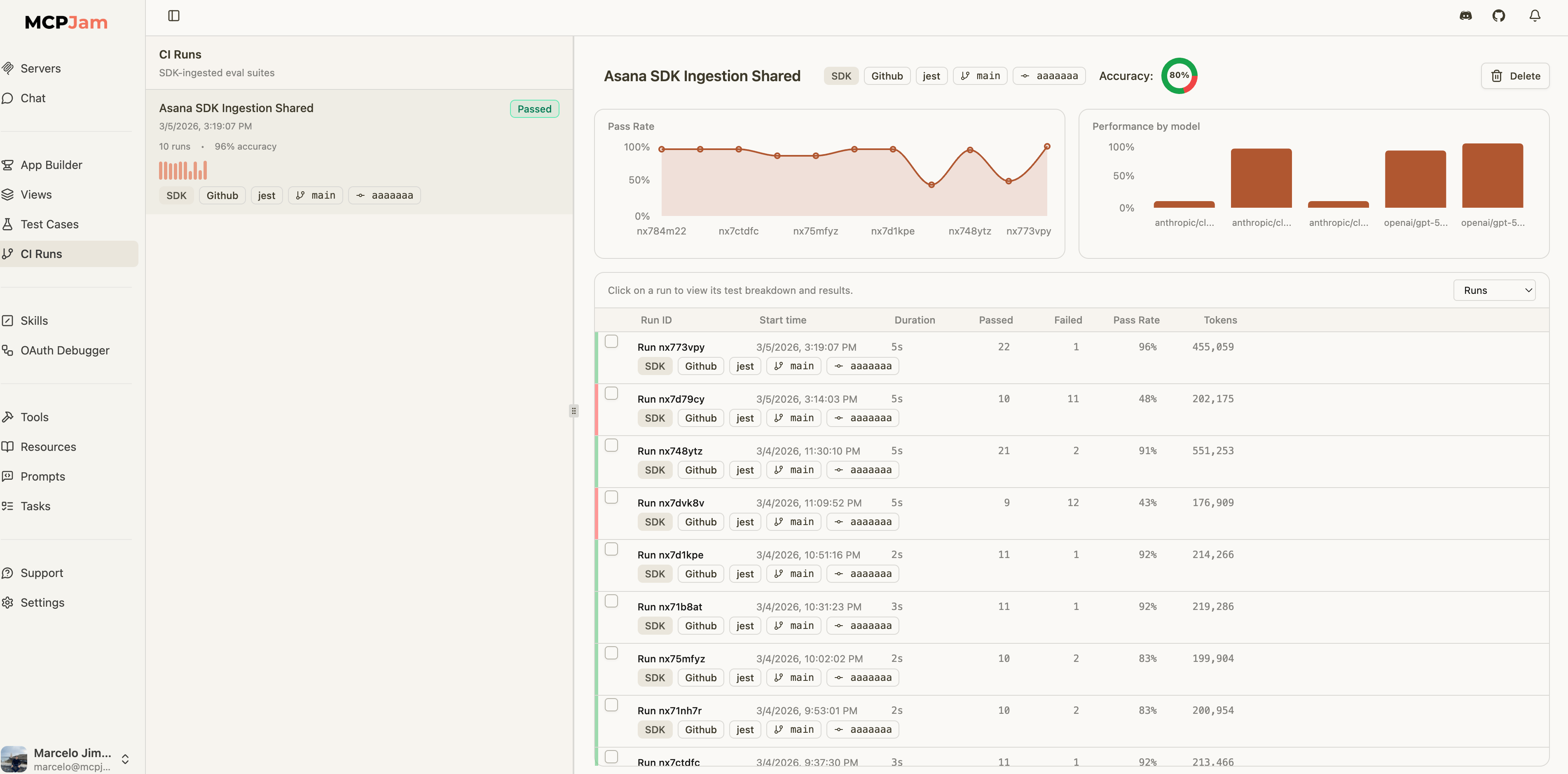
After running evals, you can save results to MCPJam to track accuracy over time, compare across branches, and get visibility in the CI Evals dashboard.
 ## Setup
Create an MCPJam API key (`sk_…`) under **Settings → API keys** and export it:
```bash theme={null}
export MCPJAM_API_KEY=sk_...
# Optional: file results under a specific project (defaults to your org's Default project).
export MCPJAM_PROJECT_ID=
```
That's it. Both `EvalTest` and `EvalSuite` auto-save results when this key is available. Results land in the project named by `MCPJAM_PROJECT_ID` (or the `project` option in the `mcpjam:` config), falling back to your organization's **Default** project.
After each successful upload the SDK prints a link to the run it just created, so you can open it straight from the terminal:
```text theme={null}
[mcpjam/sdk] View run: https://app.mcpjam.com/evals/suite/jd7.../runs/kn2...?project=jh4...
```
One line per run, on by default. See [the printed run URL](/sdk/reference/eval-reporting#the-printed-run-url) for when the `?project=` param is omitted and when nothing prints at all.
**Attach the connected `MCPClientManager` to [`HostRunner`](/sdk/reference/host-runner)** (or pass `agent` / `mcpClientManager` to manual reporting APIs) when you need either of the following:
1. **MCP App / widget replay in Evals traces** — After each MCP App tool call, the agent uses the manager’s [`readResource`](/sdk/reference/mcp-client-manager#readresource) to fetch HTML from the tool’s `ui.resourceUri` and fills [`widgetSnapshots`](/sdk/reference/prompt-result#mcp-app-widget-snapshots) on [`PromptResult`](/sdk/reference/prompt-result). Without the manager, traces still upload (messages + spans) but **widgets will not replay** in the dashboard. The tool’s JSON result alone is not enough for offline iframe replay.
2. **Replay credentials (authenticated HTTP MCP)** — The SDK can persist server connection details for debugging and reruns. You do not need to build a second secret object yourself; replay config is derived automatically when the agent or manager is attached.
## Auto-Save from EvalTest
When `MCPJAM_API_KEY` is set, `EvalTest.run()` automatically saves results:
```typescript theme={null}
await test.run(agent, {
iterations: 30,
mcpjam: {
suiteName: "Addition Eval",
passCriteria: { minimumPassRate: 90 },
},
});
```
**Tool execution:** Auto-saved payloads use the same **pass/fail rules** as the [eval reporting reference](/sdk/reference/eval-reporting#tool-execution-and-passed): failed tool calls default to `passed: false` unless you set `failOnToolError: false` on the `mcpjam` object.
For authenticated HTTP servers:
```typescript theme={null}
import { MCPClientManager, HostRunner } from "@mcpjam/sdk";
const manager = new MCPClientManager({
asana: {
url: process.env.MCP_SERVER_URL!,
refreshToken: process.env.MCP_REFRESH_TOKEN!,
clientId: process.env.MCP_CLIENT_ID!,
clientSecret: process.env.MCP_CLIENT_SECRET,
},
});
await manager.connectToServer("asana");
const agent = new HostRunner({
tools: await manager.getTools(),
model: "openai/gpt-5.6-sol",
apiKey: process.env.OPENAI_API_KEY!,
mcpClientManager: manager,
});
await test.run(agent, {
iterations: 30,
mcpjam: { suiteName: "Asana Eval" },
});
```
To disable auto-save for a specific run:
```typescript theme={null}
await test.run(agent, {
iterations: 30,
mcpjam: { enabled: false },
});
```
## Auto-Save from EvalSuite
Suites can be configured at construction or run time:
```typescript theme={null}
const suite = new EvalSuite({ name: "Math Operations" });
```
When a suite runs, individual `EvalTest` auto-saves are suppressed to avoid duplicate uploads. The suite consolidates all test results into a single run.
## Automatic CI metadata
When `ci` is omitted, the SDK reads available CI details from the environment. This works for `EvalSuite`, `EvalTest`, `reportEvalResults`, `reportEvalResultsSafely`, and `createEvalRunReporter`. API-key setup is still required.
| Service | Detected provider | Commit / branch variables |
| -------------- | ----------------- | -------------------------------------------------------------------------------------------------------------- |
| GitHub Actions | `github_actions` | `GITHUB_SHA` / `GITHUB_REF_NAME` (PRs use the source branch from `GITHUB_HEAD_REF` or supplied event metadata) |
| GitLab CI | `gitlab_ci` | `CI_COMMIT_SHA` / `CI_COMMIT_BRANCH`, then `CI_MERGE_REQUEST_SOURCE_BRANCH_NAME`, then `CI_COMMIT_REF_NAME` |
| CircleCI | `circleci` | `CIRCLE_SHA1` / `CIRCLE_BRANCH` |
| Buildkite | `buildkite` | `BUILDKITE_COMMIT` / `BUILDKITE_BRANCH` |
| Jenkins | `jenkins` | `GIT_COMMIT` / `BRANCH_NAME`, then `GIT_LOCAL_BRANCH`, then `GIT_BRANCH` |
| Vercel | `vercel` | `VERCEL_GIT_COMMIT_SHA` / `VERCEL_GIT_COMMIT_REF` |
| Netlify | `netlify` | `COMMIT_REF` / `BRANCH` |
The SDK also attaches available pipeline IDs, job IDs, and CI run URLs. Vercel attaches its deployment ID and Netlify its build ID; neither supplies a job ID or run URL through this detector. A deployed site's URL is not used as a CI run link.
Detection requires the provider's environment flag to be `true` or `1`; Jenkins uses a nonempty `JENKINS_URL` or `JENKINS_HOME`. If several providers match, the table's order wins and their fields are never mixed. Local runs and unknown CI services add no automatic metadata.
Variables must be exposed to the test process. On Vercel, enable access to [system environment variables](https://vercel.com/docs/environment-variables/system-environment-variables). Missing or invalid values are omitted: automatic fields are limited to 512 characters, run URLs must be HTTP(S), and commit values must be full Git hashes. For example, Buildkite's unresolved `HEAD` is omitted. GitHub uses the existing detector: `GITHUB_SHA` remains the evaluated commit (which may be a merge commit), and PRs use the source branch rather than a synthetic merge ref. Detection does not inspect the checkout or make network requests.
An explicit `ci` object replaces detection completely; missing fields are not filled automatically. To supply your own values:
```typescript theme={null}
const suite = new EvalSuite({
name: "Math Operations",
mcpjam: { ci: { commitSha: myCommitSha, branch: myBranch } },
});
```
To disable detection:
```typescript theme={null}
const suite = new EvalSuite({
name: "Math Operations",
mcpjam: { ci: {} },
});
```
Direct reporting APIs accept `ci` at the top level. Incremental reporters snapshot CI details when created; direct uploads snapshot them when reporting starts. Retries and chunks keep the same metadata.
## Manual Save APIs
For more control — custom test runners, CI post-steps, or framework-agnostic flows — the SDK provides dedicated APIs:
```typescript theme={null}
import {
reportEvalResults,
reportEvalResultsSafely,
createEvalRunReporter,
uploadEvalArtifact,
} from "@mcpjam/sdk";
// 1) One-shot save (strict — throws on failure)
await reportEvalResults({
suiteName: "Nightly",
mcpClientManager: manager,
results: [{ caseTitle: "healthcheck", passed: true }],
});
// 2) One-shot save (safe — returns null on failure)
const result = await reportEvalResultsSafely({
suiteName: "Nightly",
results: [{ caseTitle: "healthcheck", passed: true }],
});
// 3) Incremental reporter (long-running processes)
// Assumes `agent` was created with `mcpClientManager: manager`
const reporter = createEvalRunReporter({
suiteName: "Incremental",
agent,
});
await reporter.record({ caseTitle: "step-1", passed: true });
await reporter.record({ caseTitle: "step-2", passed: false, error: "timeout" });
const output = await reporter.finalize();
// 4) Artifact upload (JUnit XML, Jest JSON, Vitest JSON)
await uploadEvalArtifact({
suiteName: "JUnit import",
format: "junit-xml",
artifact: junitXmlString,
});
```
`reportEvalResults()` and `createEvalRunReporter()` resolve replay credentials in this order:
1. `serverReplayConfigs` if you pass it explicitly
2. `agent.getServerReplayConfigs()`
3. `mcpClientManager.getServerReplayConfigs()`
Most users should pass `agent` or `mcpClientManager` and let the SDK derive replay credentials automatically. Use `serverReplayConfigs` only as an advanced override.
When replay configs are inferred from `agent` or `mcpClientManager`, the SDK limits them to the `serverNames` you attach to the run when `serverNames` is provided.
**Manual reporters (Vitest/Jest hooks):** Pass `agent` or `mcpClientManager` into [`createEvalRunReporter`](/sdk/reference/eval-reporting#createevalrunreporter) — not only on `HostRunner` — and call **`await reporter.finalize()` before `await manager.disconnectAllServers()`** so replay config is still available at upload time. See [Replay metadata for the MCPJam UI](/sdk/reference/eval-reporting#replay-metadata-for-the-mcpjam-ui).
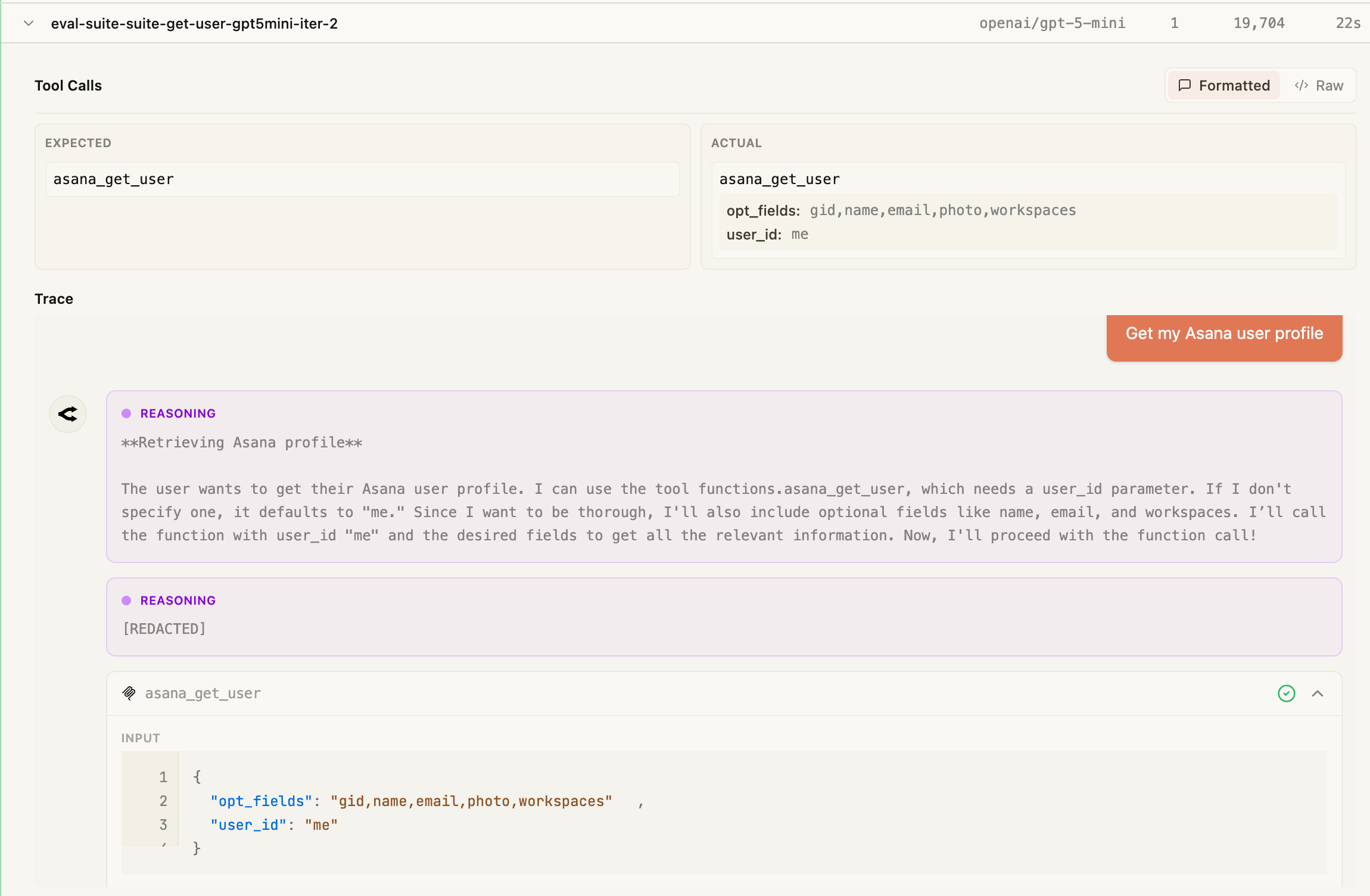
Each iteration records the expected and actual tool calls side by side, along with the model's reasoning trace, so you can pinpoint exactly why a test passed or failed:
## Setup
Create an MCPJam API key (`sk_…`) under **Settings → API keys** and export it:
```bash theme={null}
export MCPJAM_API_KEY=sk_...
# Optional: file results under a specific project (defaults to your org's Default project).
export MCPJAM_PROJECT_ID=
```
That's it. Both `EvalTest` and `EvalSuite` auto-save results when this key is available. Results land in the project named by `MCPJAM_PROJECT_ID` (or the `project` option in the `mcpjam:` config), falling back to your organization's **Default** project.
After each successful upload the SDK prints a link to the run it just created, so you can open it straight from the terminal:
```text theme={null}
[mcpjam/sdk] View run: https://app.mcpjam.com/evals/suite/jd7.../runs/kn2...?project=jh4...
```
One line per run, on by default. See [the printed run URL](/sdk/reference/eval-reporting#the-printed-run-url) for when the `?project=` param is omitted and when nothing prints at all.
**Attach the connected `MCPClientManager` to [`HostRunner`](/sdk/reference/host-runner)** (or pass `agent` / `mcpClientManager` to manual reporting APIs) when you need either of the following:
1. **MCP App / widget replay in Evals traces** — After each MCP App tool call, the agent uses the manager’s [`readResource`](/sdk/reference/mcp-client-manager#readresource) to fetch HTML from the tool’s `ui.resourceUri` and fills [`widgetSnapshots`](/sdk/reference/prompt-result#mcp-app-widget-snapshots) on [`PromptResult`](/sdk/reference/prompt-result). Without the manager, traces still upload (messages + spans) but **widgets will not replay** in the dashboard. The tool’s JSON result alone is not enough for offline iframe replay.
2. **Replay credentials (authenticated HTTP MCP)** — The SDK can persist server connection details for debugging and reruns. You do not need to build a second secret object yourself; replay config is derived automatically when the agent or manager is attached.
## Auto-Save from EvalTest
When `MCPJAM_API_KEY` is set, `EvalTest.run()` automatically saves results:
```typescript theme={null}
await test.run(agent, {
iterations: 30,
mcpjam: {
suiteName: "Addition Eval",
passCriteria: { minimumPassRate: 90 },
},
});
```
**Tool execution:** Auto-saved payloads use the same **pass/fail rules** as the [eval reporting reference](/sdk/reference/eval-reporting#tool-execution-and-passed): failed tool calls default to `passed: false` unless you set `failOnToolError: false` on the `mcpjam` object.
For authenticated HTTP servers:
```typescript theme={null}
import { MCPClientManager, HostRunner } from "@mcpjam/sdk";
const manager = new MCPClientManager({
asana: {
url: process.env.MCP_SERVER_URL!,
refreshToken: process.env.MCP_REFRESH_TOKEN!,
clientId: process.env.MCP_CLIENT_ID!,
clientSecret: process.env.MCP_CLIENT_SECRET,
},
});
await manager.connectToServer("asana");
const agent = new HostRunner({
tools: await manager.getTools(),
model: "openai/gpt-5.6-sol",
apiKey: process.env.OPENAI_API_KEY!,
mcpClientManager: manager,
});
await test.run(agent, {
iterations: 30,
mcpjam: { suiteName: "Asana Eval" },
});
```
To disable auto-save for a specific run:
```typescript theme={null}
await test.run(agent, {
iterations: 30,
mcpjam: { enabled: false },
});
```
## Auto-Save from EvalSuite
Suites can be configured at construction or run time:
```typescript theme={null}
const suite = new EvalSuite({ name: "Math Operations" });
```
When a suite runs, individual `EvalTest` auto-saves are suppressed to avoid duplicate uploads. The suite consolidates all test results into a single run.
## Automatic CI metadata
When `ci` is omitted, the SDK reads available CI details from the environment. This works for `EvalSuite`, `EvalTest`, `reportEvalResults`, `reportEvalResultsSafely`, and `createEvalRunReporter`. API-key setup is still required.
| Service | Detected provider | Commit / branch variables |
| -------------- | ----------------- | -------------------------------------------------------------------------------------------------------------- |
| GitHub Actions | `github_actions` | `GITHUB_SHA` / `GITHUB_REF_NAME` (PRs use the source branch from `GITHUB_HEAD_REF` or supplied event metadata) |
| GitLab CI | `gitlab_ci` | `CI_COMMIT_SHA` / `CI_COMMIT_BRANCH`, then `CI_MERGE_REQUEST_SOURCE_BRANCH_NAME`, then `CI_COMMIT_REF_NAME` |
| CircleCI | `circleci` | `CIRCLE_SHA1` / `CIRCLE_BRANCH` |
| Buildkite | `buildkite` | `BUILDKITE_COMMIT` / `BUILDKITE_BRANCH` |
| Jenkins | `jenkins` | `GIT_COMMIT` / `BRANCH_NAME`, then `GIT_LOCAL_BRANCH`, then `GIT_BRANCH` |
| Vercel | `vercel` | `VERCEL_GIT_COMMIT_SHA` / `VERCEL_GIT_COMMIT_REF` |
| Netlify | `netlify` | `COMMIT_REF` / `BRANCH` |
The SDK also attaches available pipeline IDs, job IDs, and CI run URLs. Vercel attaches its deployment ID and Netlify its build ID; neither supplies a job ID or run URL through this detector. A deployed site's URL is not used as a CI run link.
Detection requires the provider's environment flag to be `true` or `1`; Jenkins uses a nonempty `JENKINS_URL` or `JENKINS_HOME`. If several providers match, the table's order wins and their fields are never mixed. Local runs and unknown CI services add no automatic metadata.
Variables must be exposed to the test process. On Vercel, enable access to [system environment variables](https://vercel.com/docs/environment-variables/system-environment-variables). Missing or invalid values are omitted: automatic fields are limited to 512 characters, run URLs must be HTTP(S), and commit values must be full Git hashes. For example, Buildkite's unresolved `HEAD` is omitted. GitHub uses the existing detector: `GITHUB_SHA` remains the evaluated commit (which may be a merge commit), and PRs use the source branch rather than a synthetic merge ref. Detection does not inspect the checkout or make network requests.
An explicit `ci` object replaces detection completely; missing fields are not filled automatically. To supply your own values:
```typescript theme={null}
const suite = new EvalSuite({
name: "Math Operations",
mcpjam: { ci: { commitSha: myCommitSha, branch: myBranch } },
});
```
To disable detection:
```typescript theme={null}
const suite = new EvalSuite({
name: "Math Operations",
mcpjam: { ci: {} },
});
```
Direct reporting APIs accept `ci` at the top level. Incremental reporters snapshot CI details when created; direct uploads snapshot them when reporting starts. Retries and chunks keep the same metadata.
## Manual Save APIs
For more control — custom test runners, CI post-steps, or framework-agnostic flows — the SDK provides dedicated APIs:
```typescript theme={null}
import {
reportEvalResults,
reportEvalResultsSafely,
createEvalRunReporter,
uploadEvalArtifact,
} from "@mcpjam/sdk";
// 1) One-shot save (strict — throws on failure)
await reportEvalResults({
suiteName: "Nightly",
mcpClientManager: manager,
results: [{ caseTitle: "healthcheck", passed: true }],
});
// 2) One-shot save (safe — returns null on failure)
const result = await reportEvalResultsSafely({
suiteName: "Nightly",
results: [{ caseTitle: "healthcheck", passed: true }],
});
// 3) Incremental reporter (long-running processes)
// Assumes `agent` was created with `mcpClientManager: manager`
const reporter = createEvalRunReporter({
suiteName: "Incremental",
agent,
});
await reporter.record({ caseTitle: "step-1", passed: true });
await reporter.record({ caseTitle: "step-2", passed: false, error: "timeout" });
const output = await reporter.finalize();
// 4) Artifact upload (JUnit XML, Jest JSON, Vitest JSON)
await uploadEvalArtifact({
suiteName: "JUnit import",
format: "junit-xml",
artifact: junitXmlString,
});
```
`reportEvalResults()` and `createEvalRunReporter()` resolve replay credentials in this order:
1. `serverReplayConfigs` if you pass it explicitly
2. `agent.getServerReplayConfigs()`
3. `mcpClientManager.getServerReplayConfigs()`
Most users should pass `agent` or `mcpClientManager` and let the SDK derive replay credentials automatically. Use `serverReplayConfigs` only as an advanced override.
When replay configs are inferred from `agent` or `mcpClientManager`, the SDK limits them to the `serverNames` you attach to the run when `serverNames` is provided.
**Manual reporters (Vitest/Jest hooks):** Pass `agent` or `mcpClientManager` into [`createEvalRunReporter`](/sdk/reference/eval-reporting#createevalrunreporter) — not only on `HostRunner` — and call **`await reporter.finalize()` before `await manager.disconnectAllServers()`** so replay config is still available at upload time. See [Replay metadata for the MCPJam UI](/sdk/reference/eval-reporting#replay-metadata-for-the-mcpjam-ui).
Each iteration records the expected and actual tool calls side by side, along with the model's reasoning trace, so you can pinpoint exactly why a test passed or failed:
 ## Next Steps
Learn about EvalTest, EvalSuite, and iteration strategies
Full API reference for all saving and reporting methods
## Next Steps
Learn about EvalTest, EvalSuite, and iteration strategies
Full API reference for all saving and reporting methods